
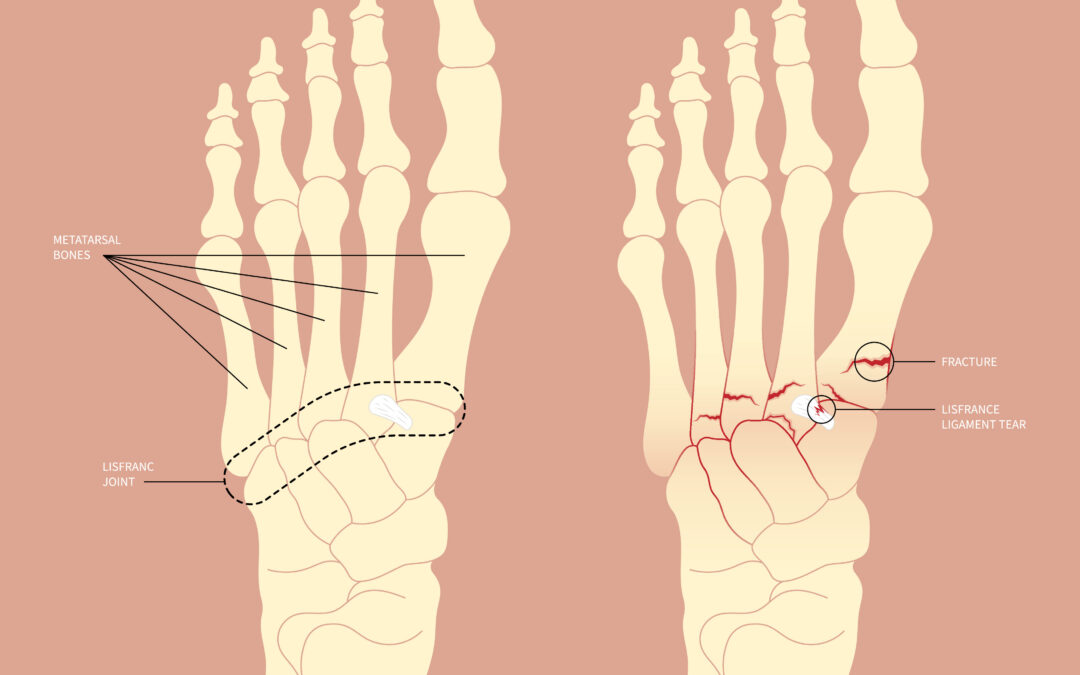
A slip on an icy sidewalk, a tumble down a flight of stairs, or a high-impact motor vehicle collision—these common scenarios frequently result in emergency room visits for foot and ankle trauma. Too often, patients are sent home with an elastic bandage, a pair of crutches, and a diagnosis of a “severe foot sprain.”
However, weeks or months later, when the swelling subsides but the patient still cannot bear weight without agonizing pain, the devastating truth emerges: they suffered a Lisfranc injury.
Because these complex midfoot injuries are notoriously difficult to detect on standard emergency room radiographs, they are among the most frequently missed diagnoses in orthopedic medicine. When a Lisfranc injury is overlooked or improperly treated, the window for an optimal recovery slams shut. The result is often lifelong disability, structural collapse of the foot, and severe, unremitting discomfort.
If you are an attorney managing a personal injury or medical malpractice claim involving severe midfoot trauma, proving the true medical and financial toll of this condition requires deep specialized knowledge. A general medical review will rarely suffice to counter aggressive defense arguments.
⚖️ Secure the Technical Medical Expertise Your Case Demands
If your client is facing long-term disability due to a missed or improperly managed midfoot fracture, minor gaps in your medical evidence can leave substantial compensation on the table. Don’t let defense counsels minimize severe midfoot trauma as a simple sprain. Contact Orthopedic Foot and Ankle Expert Services, LLC Today to schedule a professional evaluation and ensure your case is backed by a board-certified specialist.
Understanding the Anatomy: What is a Lisfranc Injury?
To successfully litigate a Lisfranc injury chronic pain lawsuit, one must first understand why the midfoot is so vital to human locomotion—and why it is so vulnerable to catastrophic failure.
The Lisfranc joint complex is the critical junction where the tarsal bones (the arch of the foot) meet the metatarsal bones (the long bones leading to the toes). The definitive anchor of this entire structure is the Lisfranc ligament, a thick band of tissue that stabilizes the second metatarsal base to the medial cuneiform.
Unlike the hand, where joints are designed for highly flexible manipulation, the midfoot joints are designed for rigid stability. They function as a solid arch that distributes weight evenly across the lower extremity during the gait cycle.
When high-energy forces push the foot into extreme hyper-plantarflexion (such as a foot caught in a stirrup during a fall, or pressed hard against a car brake during an accident), this ligament stabilizes no longer. The bones of the midfoot shift out of alignment, causing:
- Diastasis: Widening of the gap between the first cuneiform and second metatarsal base. .
- Fracture-Dislocations: Small avulsion fractures (often called the “fleck sign”) where the ligament tears away a piece of bone.
- Complete Arch Collapse: The loss of the foot’s structural integrity, causing flatfoot deformity (pes planus).
The Trap of the “Simple Sprain”: Why Misdiagnosis is So Common
The primary reason Lisfranc injuries lead to significant medical malpractice litigation is the high rate of initial misdiagnosis. In busy emergency departments or urgent care clinics, clinicians heavily rely on standard, non-weight-bearing X-rays.
When a patient is in too much pain to stand, an X-ray is taken while they are lying down. Without the force of gravity and body weight pressing down on the foot, the bones often slip back into a seemingly normal position. The critical widening between the metatarsals disappears on the film, leading the clinician to mistake a surgical ligament tear for a simple soft-tissue sprain.
Discovering this error requires advanced diagnostic protocols that non-specialist physicians frequently fail to order:
- Weight-Bearing Radiographs: X-rays taken while the patient stands on the injuried foot, forcing the bones apart to reveal hidden instability.
- Weight-Bearing CT Scans: Advanced 3D imaging that demonstrates subtle joint subluxations and micro-fractures invisible on standard film.
- Magnetic Resonance Imaging (MRI): Essential for visualizing isolated, non-displaced tears of the Lisfranc ligament complex.
When a clinic fails to execute these diagnostic measures despite localized swelling, plantar ecchymosis (bruising on the bottom of the foot), and an inability to bear weight, they may have breached the standard of care. When a clinic is unable to perform these tests, a referral to a foot and ankle specialist is critical for optimal care.
The Path to Chronic Pain and Permanent Disability
The long-term prognosis of an untreated or delayed-treatment Lisfranc injury is overwhelmingly negative. Unlike muscle or minor ankle sprains, a disrupted midfoot joint complex does not heal properly with simple rest.
[Initial Injury] ➔ [Missed Diagnosis / Delayed Care] ➔ [Chronic Instability & Friction] ➔ [Post-Traumatic Arthritis] ➔ [Surgical Fusion & Permanent Mobility Loss]
When the alignment of the midfoot is altered by even one or two millimeters, the cartilage within those small joints experiences uneven wear and tear. Over time, this friction destroys the protective cartilage, leading to rapid-onset post-traumatic arthritis.
For a plaintiff, this means transitioning from a vibrant, active lifestyle to a reality dominated by chronic pain. Every step taken causes bone-on-bone friction. Over time, this structural collapse ripples upward, altering the patient’s entire gait mechanics and triggering secondary degenerative issues in the ankle, knee, hip, and lower back.
Calculating the True Financial Valuation of Midfoot Trauma
In a personal injury or workers’ compensation lawsuit, insurance adjusters and defense counsels routinely attempt to minimize foot injuries. They may argue that because the foot is a small part of the body, the damages should be capped accordingly.
To maximize case valuation, a plaintiff’s legal team must meticulously document the extensive future medical needs associated with severe midfoot trauma. A properly structured claim must account for:
1. Advanced Surgical Interventions
Many Lisfranc injuries cannot be treated with a simple cast. They require Open Reduction and Internal Fixation (ORIF), where plates and screws are surgically implanted to hold the bones in place. Often, a second surgery is required months later just to remove this hardware. If arthritis has already set in due to a delayed diagnosis, the patient may require a midfoot arthrodesis (joint fusion), permanently eliminating natural movement in the foot.
2. Lifelong Orthotic and Prosthetic Demands
Following structural midfoot collapse, a patient can never wear standard, off-the-rack footwear comfortably. They will require expensive, custom-molded orthotics, rigid carbon-fiber shoe inserts, or specialized orthopedic footwear for the rest of their lives.
3. Impact on Earning Capacity
For individuals in labor-intensive occupations—such as construction, healthcare, law enforcement, or hospitality—a missed Lisfranc injury is often a career-ending event. The inability to stand for more than 30 consecutive minutes or walk on uneven surfaces directly translates to a massive loss of earning capacity that must be calculated and presented dynamically to a jury.
Why a General Orthopedist Is Not Enough for Court
When choosing a medical expert witness to support your case, selecting a general orthopedic surgeon is a risky compromise. While a generalist is qualified to treat basic fractures, they lack the highly specialized focus required to dissect complex foot and ankle pathology under intense cross-examination.
Defense attorneys routinely employ well-compensated medical experts who will testify that the plaintiff’s chronic pain is due to pre-existing degenerative conditions, weight issues, or natural aging rather than the accident itself.
To defeat these narratives, your case requires a sub-specialist who has dedicated their entire professional life to the intricate mechanics of the lower extremity. A board-certified foot and ankle expert can review complex medical records, analyze subtle weight-bearing imaging, and clearly articulate the exact mechanisms of causation to a judge and jury.
For more details on why general orthopedic evaluations often fall short in complex litigation, review our comprehensive guide on Why Your Personal Injury Case Needs a Specialized Orthopedic Foot & Ankle Expert Witness.
Key Strategies for Litigating a Lisfranc Malpractice or Injury Claim
To build an ironclad case around a midfoot injury, legal teams should focus on three core pillars:
| Litigation Pillar | Critical Focus Areas | Expert Witness Role |
| Establishing Liability | ER triage notes, tracking initial weight-bearing status, delays in specialized orthopedic referrals. | Demonstrates deviations from the accepted standard of care regarding diagnostic imaging protocols. |
| Proving Causation | Correlating vehicle impact data, slip-and-fall physics, or workplace trauma to the structural foot failure. | Conducts a comprehensive biomechanical analysis to link the specific incident to the midfoot ligament disruption. |
| Quantifying Damages | Compiling future surgical estimates, pain management regimens, and customized orthotic costs. | Conducts an Independent Medical Examination (IME) to define permanent impairment ratings and future medical necessity. |
By meticulously addressing each of these pillars with objective, clinical data, you transform a easily dismissed “foot pain claim” into a high-value case that demands an equitable settlement or jury verdict. For additional context on how professional medical reviews protect your filings, read our breakdown of How an Orthopedic Foot & Ankle Expert Witness Strengthens Personal Injury Cases.
Conclusion: Partner with a Proven Specialist
A Lisfranc injury chronic pain lawsuit hinges entirely on the clarity and credibility of your medical evidence. Because these injuries involve subtle structural changes that lead to catastrophic long-term consequences, general medical conclusions are easily picked apart by opposing counsel.
Securing an expert who possesses over 30 years of clinical orthopedic experience, a deep specialty in foot and ankle reconstruction, and a long history of providing credible courtroom testimony can make all the difference in your case outcome. To learn more about the operational parameters of legal medical reviews, explore our Expert Witness FAQs.
Do not let defense tactics minimize your client’s permanent mobility limitations. Equip your legal team with an authoritative medical analysis that commands respect from insurers, judges, and juries alike.
📞 Secure Authoritative Medical Testimony for Your Next Case
If you are currently preparing a complex personal injury, medical malpractice, or workers’ compensation lawsuit involving severe foot or ankle trauma, ensure your arguments are medically bulletproof. Schedule a Consultation with Dr. Mark Conklin Today to obtain the thorough, evidence-based assessments your litigation requires.